
Complexity
Impact
Topic Trend
Trending Up ↗What Is Zero Trust Security?
A Complete Enterprise Guide for 2026
Cybersecurity is undergoing one of the most significant transformations in its history. For decades, organizations relied on perimeter-based security models, where everything inside the corporate network was trusted and anything outside was considered a threat.
However, the digital landscape has changed dramatically. With the rise of cloud computing, remote work, SaaS applications, mobile devices, and increasingly sophisticated cyber threats, the traditional security perimeter has essentially disappeared.
What Is Zero Trust Security?
Zero Trust is a cybersecurity architecture that requires strict identity verification for every user, device, and application attempting to access resources, regardless of whether the request originates inside or outside the corporate network.
Unlike traditional models that assume internal networks are safe, Zero Trust assumes no entity should be trusted by default. Every request must be evaluated before access is granted.
- Verify every user and device.
- Enforce least-privilege access.
- Continuously monitor user behaviour.
- Inspect traffic and connections.
- Assume breach and minimise lateral movement.
This approach significantly reduces the ability of attackers to move inside corporate networks after gaining initial access.
Why Traditional Perimeter Security Is Failing
For many years, organizations used the castle-and-moat security model. Firewalls protected the perimeter, internal users were considered trusted, and access within the network was often relatively unrestricted.
Modern enterprise environments now extend far beyond a fixed corporate boundary.
Modern IT Environments
- Cloud applications
- Remote employees
- Mobile devices
- SaaS platforms
- Third-party integrations
- IoT systems
Key Security Weaknesses
- Insider threats
- Credential theft
- Lateral movement
- Cloud complexity
- Overprivileged users
- Fragmented security controls
Why Zero Trust Is Becoming Mandatory in 2026
Surge in Cyber Attacks
Organizations now face ransomware, supply-chain compromises, AI-driven phishing, credential stuffing, and cloud misconfiguration breaches. Zero Trust helps reduce the attack surface and contain intrusions more quickly.
Rise of Remote and Hybrid Work
Traditional VPN access can expose broad portions of the network after a user connects. Zero Trust validates each access request individually and limits users to approved applications.
Rapid Cloud Adoption
Enterprises increasingly depend on Microsoft 365, Salesforce, Google Workspace, and cloud infrastructure platforms. Security must therefore shift from protecting network locations to protecting identities, devices, and applications.
Compliance and Regulatory Pressure
Government strategies and security frameworks increasingly encourage Zero Trust practices to protect sensitive information and critical infrastructure.
Security Technology Evolution
Cloud-delivered security platforms such as Zscaler help organizations connect users directly to applications while inspecting traffic, enforcing identity policies, and reducing exposure of internal networks.
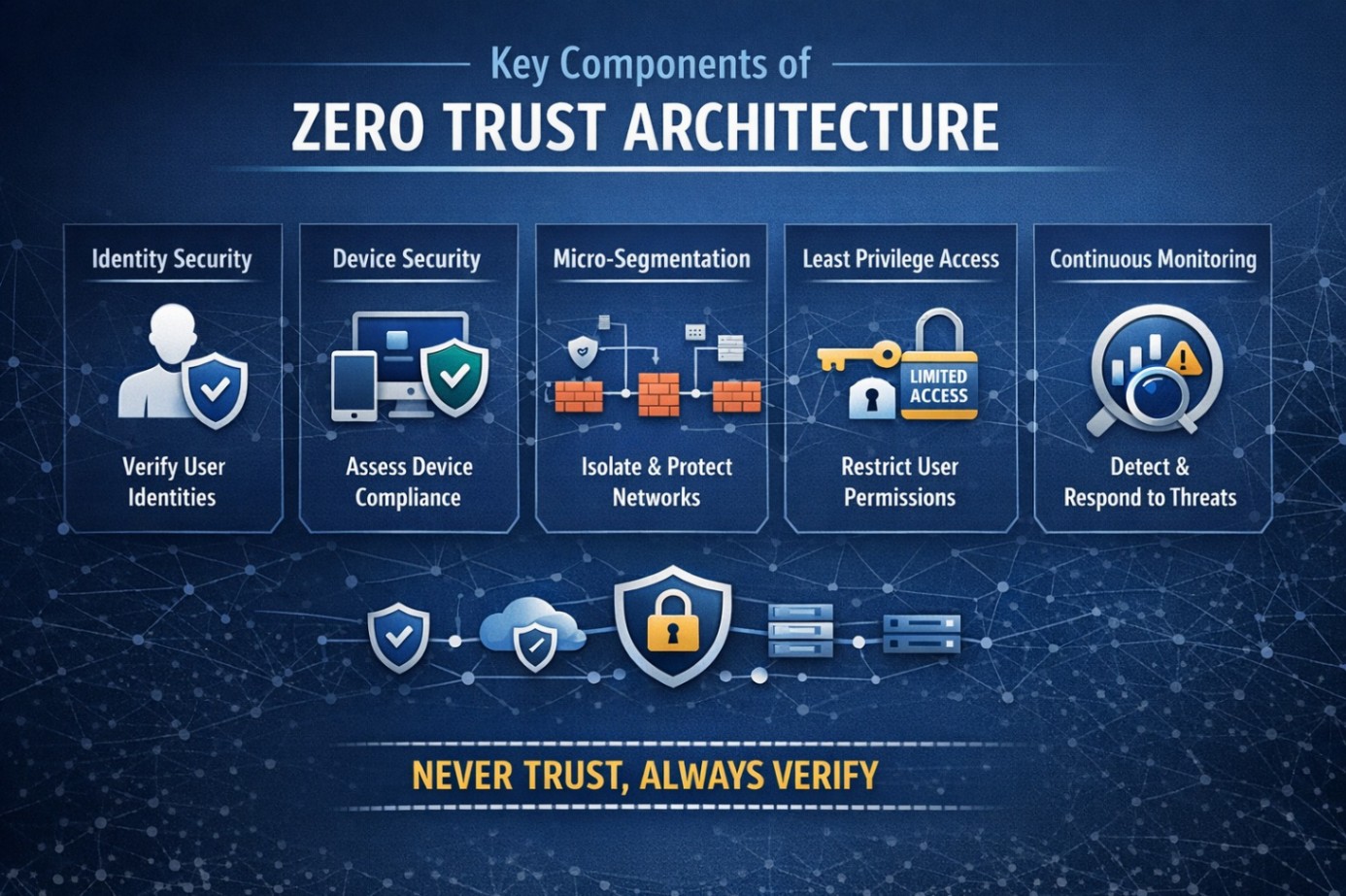
Key Components of a Zero Trust Architecture
Identity and Access Management
Verify users through MFA, identity federation, conditional access, and device posture checks.
Least-Privilege Access
Grant only the minimum permissions required for users to perform their job responsibilities.
Micro-Segmentation
Divide networks and workloads into smaller security zones to limit lateral movement.
Continuous Monitoring
Evaluate identity, device health, user behaviour, and risk throughout the session.
Secure Application Access
Connect users directly to authorised applications instead of exposing the full network.
Automated Response
Revoke or restrict access when risk, suspicious activity, or policy violations are detected.
Real Enterprise Examples of Zero Trust Adoption
Financial Institutions
Banks use Zero Trust to protect customer data, strengthen authentication, reduce ransomware risk, and restrict access to sensitive systems.
Healthcare Organizations
Healthcare providers use Zero Trust to protect electronic medical records, clinical systems, and regulated patient information.
Cloud-First Enterprises
Organizations migrating to cloud environments use Zero Trust to secure remote users, SaaS applications, and private applications.
Distributed Workforces
Global businesses apply identity-aware access policies to employees, contractors, partners, and third-party users.
How Organizations Can Adopt Zero Trust
Identify Critical Assets
Identify sensitive data, critical applications, privileged systems, and high-risk business processes.
Strengthen Identity Security
Deploy MFA, identity governance, conditional access policies, and stronger controls for privileged accounts.
Segment Infrastructure
Divide applications, networks, and workloads into smaller trust zones to reduce lateral movement.
Secure User-to-Application Connectivity
Allow users to connect directly to approved applications rather than granting broad network access.
Implement Continuous Monitoring
Use analytics and automated security controls to monitor user behaviour, identify risk, and respond to suspicious activity.
Zero Trust Consulting and Implementation Support
Implementing Zero Trust can be complex. Organizations need a clear architecture, a phased roadmap, appropriate technologies, and policies aligned with business risk.
CyberSEAL InfoSec Solutions Pvt. Ltd. supports organizations with:
- Zero Trust architecture design
- Cloud security implementation
- Identity security strategy
- Zscaler deployment and optimisation
- Security posture assessments
- Policy review and implementation planning
Learn more about our enterprise Zero Trust solutions .
Training and Skill Development for the Zero Trust Era
As Zero Trust becomes the foundation of modern cybersecurity, demand is increasing for professionals who understand identity security, cloud security, governance, and Zero Trust architecture.
CyberSEAL training and skill-development programs may cover:
- Zero Trust architecture
- Cloud security fundamentals
- Risk management and governance
- Security operations
- Incident response
Explore our cybersecurity training programs .
The Future of Cybersecurity: Zero Trust and AI
The next phase of cybersecurity will combine Zero Trust architecture with AI-driven threat detection, cloud-native security platforms, and automated incident response.
Conclusion
The cybersecurity landscape has evolved beyond traditional perimeter defence. Modern enterprises operate across cloud applications, remote users, mobile devices, and constantly changing threat environments.
Zero Trust provides a practical framework for verifying every access request, limiting privileges, securing application access, and continuously monitoring risk.
Organizations that adopt Zero Trust today will be better prepared to defend against the sophisticated cyber threats of tomorrow.
Start Your Zero Trust Journey with CyberSEAL
Speak with our cybersecurity experts about Zero Trust architecture, Zscaler deployment, identity security, and enterprise security assessments.
About the Author: CSIS Team
Our research is led by veteran security practitioners with decades of experience in global regulatory compliance, offense-defense security operations, and strategic risk management.
Related Articles
General
India’s ICS & SCADA Systems Need a Security Rethink—Before Attackers Force One
India’s ICS and SCADA environments face growing cyber risk from legacy systems, weak segmentation, insecure remote access and sophisticated threat actors. This case-study-driven guide explains how layered security, MFA, network segmentation and Zero Trust can help protect critical industrial systems.
Security Operations
AI Security in 2026: Shadow AI, Risks and Zero Trust
AI adoption can improve productivity but also introduce Shadow AI, sensitive-data leakage, prompt injection and excessive access. Learn how governance, data protection and Zero Trust can help organizations secure AI systems, users and autonomous agents.
Cloud
Cisco Duo for Small and Medium Businesses: Easy MFA and IdP Integration
Discover how Cisco Duo can help SMEs deploy strong multi-factor authentication, simplify access through existing identity systems and protect users, devices and applications. Cyberseal InfoSec Solutions can manage the complete Cisco Duo journey—from assessment and integration to rollout, optimisation and ongoing support.
Strategy
What is Zero Trust
Zero Trust is a modern cybersecurity approach built on the principle of “never trust, always verify.” It ensures that every user, device, and application is continuously authenticated before accessing resources, reducing the risk of unauthorized access and data breaches.
Strategy
A Strategic Milestone: Cyberseal & iMobics Redefine AI-Driven Security
Cyberseal’s partnership with iMobics marks a defining milestone in delivering proactive, AI-powered cybersecurity. By combining patented Authentic AI technology with managed security expertise, we are building a smarter, faster, and future-ready defense model for modern businesses.