Complexity
Impact
Topic Trend
Trending Up ↗Cisco Duo for Small and Medium Businesses: Easy MFA and IdP Integration
Small and medium businesses need strong identity security without the complexity of building a large IAM team. Cisco Duo helps organizations strengthen authentication, integrate with existing identity systems and move toward Zero Trust without replacing their entire technology environment.
Identity Is Now a Critical Security Perimeter
Small and medium businesses increasingly depend on cloud applications, remote access, SaaS platforms, Microsoft 365, VPNs and hybrid work. As the number of digital services grows, passwords alone become an increasingly weak security control.
A compromised employee account can potentially provide an attacker with access to email, files, applications and other business resources. For an SMB with a small IT team, responding to an identity compromise can consume significant time and resources.
This is where multi-factor authentication (MFA) and centralized identity controls become particularly valuable.
Why MFA Matters for Small and Medium Businesses
Passwords can be stolen through phishing, credential stuffing, malware, password reuse and social engineering. MFA adds another verification step, making a stolen password less useful to an attacker.
MFA is especially important for accounts that provide access to business-critical applications, remote access infrastructure, administrative systems and cloud services.
Stronger Authentication
Add an additional verification layer beyond the username and password.
Reduce Account Risk
Make compromised passwords less sufficient for unauthorized access.
Protect Cloud Access
Strengthen authentication for SaaS, remote and hybrid-work environments.
What Is Cisco Duo?
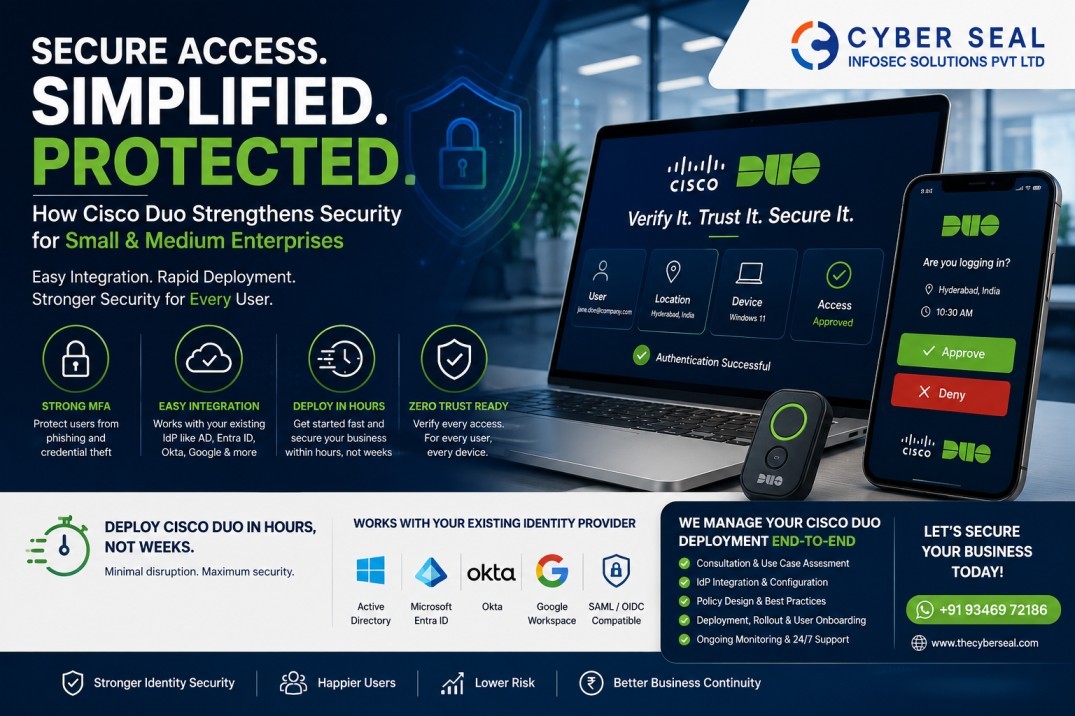
Cisco Duo is an identity-security platform focused on strengthening authentication and access. For businesses, Duo can provide MFA and integrate with existing directories and identity providers rather than requiring a complete identity-system replacement.
CyberSEAL's managed Cisco Duo service specifically supports organizations that want to deploy, configure and operate Duo without building a dedicated internal Duo operations function.
According to CyberSEAL's current managed-service offering, supported integration targets include Active Directory, Microsoft Entra ID, Google Workspace and supported SAML identity providers. :contentReference[oaicite:0]{index=0}
Key Benefits of Cisco Duo for SMBs
Easy MFA
Add strong authentication to supported business applications and access workflows.
Existing IdP Integration
Work with an existing identity provider rather than rebuilding the entire identity environment.
Centralized Policies
Apply consistent authentication and access policies across supported applications.
Remote Access Security
Strengthen authentication for supported VPN and remote-access environments.
Zero Trust Ready
Use identity verification as an important layer of a broader Zero Trust strategy.
Managed Operations
SMBs can use managed expertise for administration, troubleshooting and ongoing policy optimization.
Cisco Duo and Identity Provider Integration
One of the biggest concerns for an SMB evaluating a new identity security platform is whether it will force the organization to replace existing systems.
Cisco Duo can act as an additional security layer around supported identity environments. CyberSEAL describes its managed service as supporting integration with existing directories and identity providers, including Active Directory, Microsoft Entra ID, Google Workspace and supported SAML/OIDC applications. :contentReference[oaicite:1]{index=1}
| Existing Environment | Potential Duo Role | Business Benefit |
|---|---|---|
| Active Directory | Identity and authentication security | Strengthen access without immediately replacing the directory. |
| Microsoft Entra ID | Additional identity-security and MFA capabilities | Extend authentication protection across supported workflows. |
| Google Workspace | Identity and authentication integration | Support stronger authentication for cloud-centric teams. |
| Supported SAML/OIDC applications | Application authentication integration | Centralize access controls for supported SaaS applications. |
What Can Cisco Duo Protect?
An SMB does not necessarily need to deploy MFA everywhere on day one. A risk-based rollout can begin with the access points that matter most.
Microsoft 365 & SaaS
Strengthen authentication for productivity and cloud applications where supported.
VPN & Remote Access
Add MFA to supported remote-access and VPN environments.
Windows Logon & RDP
Protect supported Windows logon and Remote Desktop workflows.
Privileged Accounts
Apply stronger controls to administrators and other high-risk identities.
Contractors & Partners
Establish controlled authentication for external users where supported.
Hybrid Workforce
Apply consistent identity-security principles across office and remote workers.
CyberSEAL's managed Cisco Duo service specifically lists application, VPN, Windows logon, remote-access and supported SaaS integration among its managed capabilities. :contentReference[oaicite:2]{index=2}
Cisco Duo as Part of a Zero Trust Strategy
Zero Trust is based on the principle that access should not be trusted simply because a user or device is inside a corporate network. Authentication, authorization and context should be evaluated before access is granted.
Identity therefore becomes an important control point.
Verify the User
Require strong authentication before granting access.
Evaluate Context
Consider device and access context where the technology and policy support it.
Apply Least Privilege
Give users and applications only the access they require.
Protect Applications
Focus security controls around the applications and resources being accessed.
Organizations building a broader Zero Trust program can also explore CyberSEAL's Zero Trust Jumpstart , which focuses on architecture, pilot deployment, identity integration and rollout.
Practical SMB Use Cases
Use Case 1: Protecting Microsoft 365 Users
An organization with employees using cloud email and productivity applications can prioritize identity protection for employees, administrators and other high-value accounts.
Use Case 2: Securing Remote Employees
Remote workers frequently access business resources from networks outside the corporate office. MFA provides an additional authentication layer for supported remote-access workflows.
Use Case 3: Protecting Administrators
Administrative identities deserve stronger protection because a compromised privileged account can have significantly greater impact than a standard user account.
Use Case 4: Supporting Contractors and Partners
Businesses that work with external users can establish controlled identity and authentication policies for supported applications and access workflows.
Use Case 5: Building Toward Zero Trust
SMBs do not have to implement a massive Zero Trust transformation immediately. Strengthening identity and MFA can be a practical first step toward a broader identity-aware security architecture.
How to Deploy Cisco Duo in an SMB Environment
A phased implementation reduces disruption and gives the IT team an opportunity to validate authentication, user enrollment and policy behaviour before expanding the rollout.
Assess
Identify the identity provider, applications, users, remote-access services and security requirements.
Configure
Establish the Duo environment and administrative configuration.
Integrate
Connect the supported identity source and selected applications.
Protect
Apply MFA and access policies to the first high-priority application or workflow.
Enroll & Test
Enroll pilot users and validate authentication, recovery and support procedures.
Go Live
Expand the approved configuration into production and continue with additional applications.
Why a Managed Cisco Duo Service Can Help SMBs
Buying an MFA platform is only part of the identity-security journey. Someone still needs to configure policies, enroll users, troubleshoot authentication issues, onboard applications and review the environment over time.
For organizations with limited internal IAM expertise, a managed service can reduce the operational burden.
| SMB Challenge | Managed Duo Approach | Potential Outcome |
|---|---|---|
| Limited IAM expertise | End-to-end configuration and administration support | Lower internal operational workload |
| Inconsistent MFA deployment | Centralized policy and application onboarding | More consistent identity protection |
| User enrollment problems | Enrollment and support assistance | Smoother adoption |
| Changing business applications | Ongoing application onboarding and policy management | Security can scale with the business |
| Remote-access requirements | Support for supported VPN and remote-access integrations | Stronger remote authentication |
CyberSEAL currently describes its managed Cisco Duo service as covering tenant setup, IdP integration, MFA policy design, supported SSO configuration, application onboarding, user enrollment, troubleshooting, policy review and ongoing optimization. :contentReference[oaicite:4]{index=4}
SMB Cisco Duo Implementation Checklist
Inventory Users
Identify employees, administrators, contractors and other users requiring protected access.
Inventory Applications
Identify cloud applications, VPNs, remote-access services and critical business systems.
Identify the IdP
Document the current directory or identity provider and integration requirements.
Prioritize Risk
Start with privileged accounts, sensitive applications and remote-access workflows.
Pilot First
Test authentication and enrollment with a controlled user group before broad deployment.
Plan Support
Prepare user communications, recovery procedures and ongoing administration processes.
Cisco Duo vs. Password-Only Access
| Security Area | Password Only | MFA with Cisco Duo |
|---|---|---|
| Authentication | Primarily dependent on password security | Adds another authentication factor |
| Phishing resilience | Compromised credentials may be sufficient | Additional verification can reduce the value of stolen passwords |
| Remote access | Password is a major control | MFA can strengthen supported access workflows |
| Identity governance | Often fragmented across applications | Centralized policies can improve consistency |
| Zero Trust readiness | Limited identity assurance | Stronger foundation for identity-centric access controls |
How Cisco Duo Fits Into a Broader Security Strategy
MFA should not be treated as the entire cybersecurity program. Identity security works best as one layer within a broader defense strategy.
Identity Security
Strengthen authentication and access controls with MFA and identity-aware policies.
Security Monitoring
Monitor security events and investigate suspicious activity through broader security operations.
Governance
Align identity controls with security policies, regulatory requirements and business risk.
SMBs can complement identity controls with CyberSEAL's vCISO services , vulnerability management , managed Zscaler security and security awareness training .
Frequently Asked Questions
What is Cisco Duo?
Cisco Duo is an identity-security platform that can strengthen authentication and access through MFA and supported identity and application integrations.
Is Cisco Duo suitable for small businesses?
Yes. Cisco Duo can be useful for SMBs that want stronger authentication without necessarily replacing their existing identity environment. The appropriate deployment depends on the organization's applications, identity architecture and security requirements.
Do we need to replace our existing identity provider?
Not necessarily. CyberSEAL's managed Duo offering supports integration with existing directories and supported identity providers, including Active Directory, Microsoft Entra ID and Google Workspace. :contentReference[oaicite:5]{index=5}
Can Cisco Duo protect VPN access?
Cisco Duo can be integrated with supported VPN and remote-access solutions. The exact integration depends on the VPN technology, configuration and supported Duo capabilities.
Can Cisco Duo protect Microsoft 365?
Duo can support identity and authentication use cases around supported cloud applications. The exact implementation should be assessed against the organization's Microsoft 365 and identity architecture.
Can CyberSEAL manage Cisco Duo after implementation?
Yes. CyberSEAL describes its managed Duo service as covering administration, user enrollment, troubleshooting, application onboarding, policy review and ongoing optimization. :contentReference[oaicite:6]{index=6}
Can Cisco Duo support a Zero Trust strategy?
Yes. Strong identity verification is an important component of Zero Trust. Duo can form part of a broader Zero Trust architecture where access is based on identity, policy and context.
How quickly can Cisco Duo be deployed?
CyberSEAL states that eligible pilots and straightforward initial integrations can begin within hours. Full deployment timelines vary according to application compatibility, approvals, policy complexity, testing and change requirements. :contentReference[oaicite:7]{index=7}
Does a managed Duo service reduce the IT workload?
It can. A managed service can take responsibility for configuration, administration, troubleshooting, application onboarding and policy optimization, reducing the amount of specialized IAM work handled internally.
Conclusion: Strong MFA Without Unnecessary Complexity
For small and medium businesses, identity security does not have to mean an expensive or complicated transformation. Strong MFA can provide an important additional layer of protection against compromised credentials while supporting modern cloud and remote-work environments.
Cisco Duo can be particularly useful where an organization wants to strengthen authentication while continuing to use its existing identity provider and business applications where supported.
The most effective approach is to begin with high-value identities and applications, run a controlled pilot, communicate clearly with users and then expand the deployment based on risk.
Ready to Strengthen Your SMB's Identity Security?
CyberSEAL provides managed Cisco Duo identity security, including assessment, IdP integration, MFA configuration, application onboarding, user enrollment, troubleshooting and ongoing optimization.
Explore Managed Cisco Duo Request an IAM Assessment Explore Zero TrustFurther Reading & References
About the Author: Sanjay Verma, CISSP, CCSP, C|CISO
Our research is led by veteran security practitioners with decades of experience in global regulatory compliance, offense-defense security operations, and strategic risk management.
Related Articles
General
India’s ICS & SCADA Systems Need a Security Rethink—Before Attackers Force One
India’s ICS and SCADA environments face growing cyber risk from legacy systems, weak segmentation, insecure remote access and sophisticated threat actors. This case-study-driven guide explains how layered security, MFA, network segmentation and Zero Trust can help protect critical industrial systems.
Security Operations
AI Security in 2026: Shadow AI, Risks and Zero Trust
AI adoption can improve productivity but also introduce Shadow AI, sensitive-data leakage, prompt injection and excessive access. Learn how governance, data protection and Zero Trust can help organizations secure AI systems, users and autonomous agents.
Strategy
What is Zero Trust
Zero Trust is a modern cybersecurity approach built on the principle of “never trust, always verify.” It ensures that every user, device, and application is continuously authenticated before accessing resources, reducing the risk of unauthorized access and data breaches.
Zero Trust
Why Zero Trust Security Is Becoming Mandatory in 2026
Zero Trust is a modern security approach based on the principle “Never Trust, Always Verify.” It ensures that every user, device, and application is continuously authenticated and authorized before accessing resources. This model helps organizations protect sensitive data, reduce cyber risks, and strengthen overall security in today’s cloud and remote-work environments.
Strategy
A Strategic Milestone: Cyberseal & iMobics Redefine AI-Driven Security
Cyberseal’s partnership with iMobics marks a defining milestone in delivering proactive, AI-powered cybersecurity. By combining patented Authentic AI technology with managed security expertise, we are building a smarter, faster, and future-ready defense model for modern businesses.