
Complexity
Impact
Topic Trend
Trending Up ↗AI Security in 2026: Shadow AI, Risks and Zero Trust
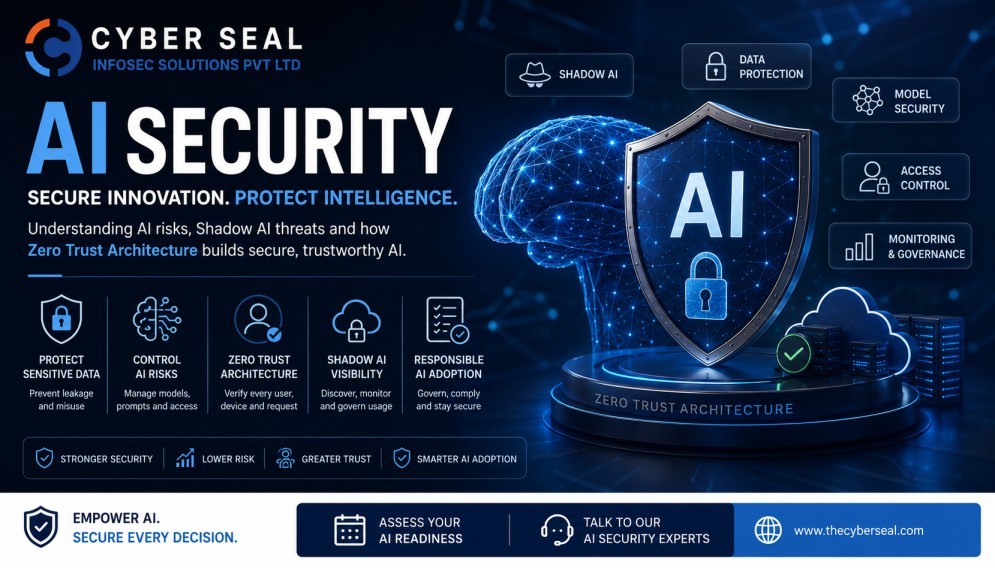
AI is becoming part of everyday business workflows—but organizations cannot secure what they cannot see. In 2026, AI security is increasingly about controlling unsanctioned AI use, protecting sensitive information, managing identity and access, validating AI-generated output, and applying Zero Trust principles to people, applications, data and AI services.
AI Adoption Has Outpaced Traditional Security Assumptions
Artificial intelligence is no longer limited to specialist data science teams. Employees use AI assistants to write emails, analyse documents, summarize meetings, generate code, research customers, create presentations and automate repetitive work.
The security problem is not AI itself. The problem emerges when AI applications, models, browser extensions, APIs and automated agents become part of business processes without appropriate visibility, authorization, data controls and governance.
This is where Shadow AI becomes important. Employees may adopt AI services before security teams have evaluated their data handling, retention, authentication, integration and privacy characteristics.
What Is AI Security?
AI security is the set of technologies, processes and governance practices used to protect AI systems, the data they consume, the identities that access them and the business processes that depend on their outputs.
The scope extends beyond protecting a machine-learning model. Enterprise AI security may include generative AI applications, internal copilots, AI APIs, AI agents, model infrastructure, third-party AI services and applications that embed AI capabilities.
Data Protection
Prevent sensitive, confidential or regulated information from being unnecessarily exposed to AI systems.
Identity Security
Control which users, applications and agents can access AI systems and the data behind them.
Application Security
Secure AI-enabled applications, APIs, integrations and surrounding infrastructure.
Model Security
Protect models and AI pipelines from manipulation, abuse, unauthorized access and unsafe deployment.
AI Governance
Establish policies, ownership, risk classification and accountability for business AI usage.
Monitoring
Detect unusual AI usage, risky applications, excessive access and suspicious activity.
What Is Shadow AI?
Shadow AI refers to the use of AI tools, services, models or AI-enabled applications within an organization without appropriate security approval, governance or visibility.
It is closely related to Shadow IT, but AI introduces additional concerns because users may directly submit business information to external systems or use AI-generated content inside important business decisions.
Examples of Shadow AI
Employees paste internal documents into consumer AI services to summarize or rewrite them.
Developers use unapproved AI tools with proprietary source code, configuration or credentials.
Users install extensions that can read pages, documents or application content.
Automated transcription or summarization services process internal meetings without security review.
Employees connect autonomous or semi-autonomous agents to SaaS applications without appropriate permission controls.
Developers integrate external model APIs into applications without going through security and privacy review.
Why Shadow AI Is Growing
AI applications reduce the time required for many knowledge-work tasks. When a tool provides an immediate productivity benefit, employees may adopt it before an organization's formal technology approval process catches up.
The resulting security challenge is often a governance gap rather than malicious intent. An employee may genuinely believe that uploading a document to an AI assistant is harmless because the activity feels similar to using a search engine.
Major AI and Shadow AI Security Risks
AI risk is multidimensional. Organizations should evaluate both the technology and the business process surrounding it.
| Risk | Example | Potential Business Impact | Useful Control |
|---|---|---|---|
| Data exposure | Confidential document submitted to an external AI service. | Privacy, confidentiality or regulatory exposure. | Data classification, DLP and approved-AI policies. |
| Excessive permissions | AI agent receives broad access to SaaS applications. | Unauthorized changes, data access or business disruption. | Least privilege and identity-aware access. |
| Prompt injection | Untrusted content attempts to manipulate an AI-enabled application. | Data disclosure or unintended actions. | Input validation, isolation and controlled tool access. |
| Hallucination | AI produces an incorrect answer that is treated as fact. | Bad decisions, compliance problems or operational errors. | Human validation and high-risk workflow controls. |
| Supply-chain risk | Third-party model, plugin or AI component is compromised. | Integrity, confidentiality or availability impact. | Vendor assessment and software/model governance. |
| Credential abuse | AI-connected service account is compromised. | Unauthorized access to connected systems. | MFA, secrets management and scoped permissions. |
1. Data Leakage: The First Shadow AI Question
Data leakage is one of the easiest Shadow AI risks to understand. The security team needs to know whether employees are submitting information that the organization would not normally disclose to an unapproved third party.
Potentially Sensitive Inputs
- Customer personal information
- Financial information
- Source code and proprietary algorithms
- Security configurations
- Internal architecture diagrams
- Contracts and confidential documents
- Credentials, tokens or secrets
- Incident-response information
- Unreleased business strategy
2. Identity and Access Risk
AI changes the identity landscape because an AI application or agent can become more than a passive tool. Depending on its design, it may access files, send messages, query databases, create tickets or interact with business applications.
Every such connection introduces an authorization decision.
Apply Least Privilege to AI Agents
- Give an AI application only the permissions it actually needs.
- Separate read and write permissions where possible.
- Restrict access to sensitive applications and datasets.
- Use separate service identities instead of shared credentials.
- Rotate and protect API keys and secrets.
- Monitor high-impact actions initiated through AI.
- Review permissions when workflows or models change.
3. AI Output Is Not Automatically Trustworthy
Security teams often focus on malicious AI behaviour while overlooking a simpler problem: an AI system can produce incorrect or misleading information without being compromised.
This matters when AI output influences security investigations, financial decisions, customer communications, legal documents, software development or operational processes.
4. AI Supply-Chain Risk
An enterprise AI deployment can depend on multiple external components: model providers, APIs, plugins, libraries, datasets, cloud platforms and third-party integrations.
Security teams therefore need to ask not only “Is our AI application secure?” but also “What does our AI application depend on?”
Understand security, privacy, data handling and incident-response commitments.
Maintain awareness of important software, APIs and services.
Review material changes to models, integrations and AI workflows.
Understand how data and business processes can be migrated if a provider becomes unsuitable.
5. Prompt Injection and AI Application Security
AI applications can process both trusted instructions and untrusted content. This creates a new class of application-security concerns where malicious or manipulated content may influence how an AI system interprets instructions.
For example, an AI assistant connected to internal documents could encounter content specifically designed to manipulate the assistant's behaviour. If the application also has access to sensitive tools, email or databases, the consequences can become more serious.
Security Design Principles
- Do not treat model output as inherently trustworthy.
- Separate instructions from untrusted retrieved content.
- Limit the tools available to an AI agent.
- Require authorization for sensitive actions.
- Validate high-impact AI-generated actions before execution.
- Log important prompts, actions and security decisions where appropriate.
The OWASP Top 10 for Large Language Model Applications is a useful reference for understanding risks such as prompt injection, insecure output handling, excessive agency and supply-chain concerns.
6. AI-Enabled Social Engineering and Deepfakes
AI can improve the quality and scale of phishing, impersonation and social-engineering campaigns. Attackers can use generative systems to produce convincing messages, imitate communication styles and automate content creation.
Organizations should therefore avoid security awareness models that rely only on spotting spelling mistakes or obviously suspicious messages.
AI Security and Zero Trust: A Natural Partnership
Zero Trust provides a useful security philosophy for AI environments: do not grant implicit trust merely because a user, application, device or AI agent is inside a corporate environment.
Instead, access should be evaluated using identity, device context, application, resource sensitivity, risk and policy.
Verify Explicitly
Verify users, devices and applications before granting access to AI resources or connected business systems.
Use Least Privilege
Give AI applications and agents the minimum permissions required for their defined purpose.
Assume Breach
Design workflows so a compromised AI identity or application cannot automatically access everything.
Organizations exploring Zero Trust can also review CyberSEAL's Zero Trust Jumpstart for an example of an enterprise Zero Trust architecture and implementation approach.
Identity Becomes the AI Control Plane
As AI applications become integrated with business systems, identity becomes one of the most important enforcement points.
| Identity | Security Question | Recommended Direction |
|---|---|---|
| Employee | Who is using the AI service? | Strong authentication and appropriate access policies. |
| AI application | Which resources can the application access? | Application identity and scoped permissions. |
| AI agent | What actions can it execute? | Least privilege, authorization and action controls. |
| Service account | Where are its credentials used? | Secrets management, rotation and monitoring. |
CyberSEAL also provides managed identity security using Cisco Duo managed IAM to strengthen authentication and Zero Trust access controls.
Protecting Data in an AI-Enabled Enterprise
AI governance becomes much easier when an organization already has a mature data-classification and access-control program.
A Practical Data-Control Model
Classify
Identify public, internal, confidential and highly sensitive information.
Define
Establish which AI services may process each data category.
Control
Use identity, DLP, browser, endpoint and network controls to enforce policy where technically feasible.
Monitor
Look for unusual AI applications, data transfers and access patterns.
How Can Security Teams Discover Shadow AI?
A policy alone will not reveal Shadow AI. Security teams need a combination of discovery, telemetry and employee engagement.
Network Visibility
Identify traffic to known AI services and unusual destinations.
Endpoint Visibility
Identify unauthorized applications, extensions and AI clients.
Cloud Visibility
Understand SaaS and cloud applications being used across the organization.
Identity Logs
Correlate user identities, applications and access patterns.
Data Controls
Identify attempts to move sensitive information into unauthorized destinations.
Employee Feedback
Ask employees which AI tools they actually use. Discovery should not depend exclusively on technical telemetry.
AI Governance: From “Ban AI” to “Manage AI”
A blanket AI ban is unlikely to be sustainable for organizations where employees can access public AI services from personal devices or external networks.
A stronger approach is to define an approved AI usage framework.
| Policy Area | Example Question |
|---|---|
| Approved tools | Which AI services are approved for business use? |
| Data handling | What information may employees submit to each service? |
| Identity | Should business AI services use corporate identities? |
| Third parties | What security and privacy requirements apply to AI vendors? |
| High-risk use | Which AI decisions require mandatory human review? |
| Incident response | What happens if sensitive information is submitted to an unauthorized AI service? |
| Review cycle | How often are AI tools, risks and policies reassessed? |
The NIST AI Risk Management Framework provides a useful structure for organizations developing AI governance and risk-management practices.
Technical Controls for Shadow AI and AI Security
Organizations should build a layered control model rather than depending on one AI-security product.
Secure access to enterprise AI applications and connected services.
Restrict AI applications and agents to required permissions.
Reduce unauthorized movement of sensitive information into AI tools.
Control access to risky or unauthorized AI services where policy requires it.
Detect unauthorized AI applications, extensions and integrations.
Retain useful security telemetry for investigation and governance.
Test AI-enabled applications for abuse, injection and authorization weaknesses.
Evaluate AI providers, integrations and third-party dependencies.
CyberSEAL's Managed Zscaler Services can also support organizations building cloud-delivered security controls around users, applications, web traffic and Zero Trust access.
People Still Matter: Build AI Security Awareness
Security controls are important, but employees remain a critical part of AI governance. The objective should be to make secure AI use simple enough that employees do not need to bypass security controls to be productive.
Employees Should Know
- Which AI tools are approved.
- What information they may enter into AI tools.
- Why confidential information requires special handling.
- How to recognize AI-generated phishing and impersonation.
- How to report accidental AI data exposure.
- When AI-generated output requires human validation.
- Why connecting an AI agent to business systems requires approval.
CyberSEAL also provides security awareness and training designed around practical employee behaviour rather than purely compliance-driven presentations.
A Practical AI Security Roadmap for 2026
Organizations do not need to solve every AI-security problem at once. A phased approach can establish visibility and governance before introducing more advanced controls.
Discover
Identify AI services, applications, browser extensions, APIs, agents and AI-enabled business processes already in use.
Classify
Categorize AI use according to data sensitivity, business impact, autonomy and regulatory requirements.
Govern
Create approved-use policies, ownership models, review criteria and escalation procedures.
Control
Apply identity, access, DLP, endpoint, network and application security controls according to risk.
Monitor
Detect unauthorized AI usage, suspicious access, risky data movement and abnormal AI-enabled activity.
Improve
Reassess AI services, policies, threats and business use cases as the organization's AI footprint evolves.
Questions Security Leaders Should Ask in 2026
- Do we know which AI services employees are actually using?
- Can employees submit confidential information to public AI tools?
- Which AI applications have access to corporate data?
- Which AI agents can perform actions rather than simply provide information?
- Are AI identities and service accounts protected with appropriate controls?
- Do we have a clear approved-AI policy?
- Can we detect Shadow AI?
- How would we investigate an accidental AI data disclosure?
- Which AI-generated decisions require human approval?
- Have we assessed our critical AI vendors and integrations?
Where CyberSEAL Can Help
AI security intersects with identity, Zero Trust, cloud security, vulnerability management, governance, monitoring and security awareness. A mature program therefore needs controls across multiple layers.
AI-Driven Cyber Risk
Identify external exposure, Shadow IT, data risks and other security signals using AI-assisted cyber-risk discovery.
Explore AI-Driven Protection →Zero Trust
Strengthen identity-aware access and Zero Trust architecture for users, applications and modern work environments.
Explore Zero Trust →Managed IAM
Strengthen MFA, identity controls and access policies around applications and users.
Explore Managed IAM →Zscaler Managed Security
Apply cloud-delivered web and access controls that can form part of a broader Shadow IT and Zero Trust strategy.
Explore Zscaler Services →GRC & Compliance
Connect AI security requirements with organizational risk, policies, compliance and executive governance.
Explore GRC Services →vCISO
Establish executive-level security strategy, risk management, governance and security-roadmap oversight.
Explore vCISO Services →Frequently Asked Questions
What is Shadow AI?
Shadow AI is the use of AI applications, services, models or integrations within an organization without appropriate security, privacy or governance approval. It can include public AI assistants, coding tools, browser extensions, AI meeting applications and autonomous agents.
Why is Shadow AI a cybersecurity risk?
Shadow AI can create unknown data flows, unauthorized access, third-party exposure and unmanaged integrations. The risk becomes greater when employees submit confidential information or connect AI tools to business applications without security review.
Should organizations ban ChatGPT and other AI tools?
A complete ban may not be practical for many organizations. A better approach is usually to define approved AI tools, acceptable data usage, prohibited activities, access requirements and monitoring expectations based on business risk.
How does Zero Trust help with AI security?
Zero Trust encourages organizations to verify access rather than automatically trust users, devices or applications. This is useful for AI because AI applications and agents may interact with sensitive data and business systems and therefore need explicit, risk-aware authorization.
Can DLP prevent Shadow AI?
DLP can help reduce the unauthorized transfer of sensitive information to AI services, but it is only one layer. Effective Shadow AI governance also requires discovery, identity controls, web security, endpoint visibility, employee awareness and clear policies.
What data should employees never put into public AI tools?
Organizations should define this through their data-classification policy. In general, credentials, secrets, highly confidential customer information, sensitive personal information, proprietary source code and other restricted information should not be entered into an AI service unless the organization has explicitly approved the use case and data handling.
What is prompt injection?
Prompt injection is a class of attack in which untrusted content attempts to influence an AI application's instructions or behaviour. The risk becomes more significant when an AI system can access sensitive information or perform actions through connected tools.
Are AI agents more dangerous than normal AI assistants?
They can introduce additional risk because an agent may have the ability to perform actions rather than simply generate information. The security priority should therefore include tightly scoped permissions, authorization, monitoring and human approval for high-impact actions.
How can a company discover Shadow AI?
Organizations can combine network and DNS visibility, endpoint telemetry, cloud application discovery, identity logs, browser controls, DLP and employee surveys. No single discovery mechanism is guaranteed to identify every AI service.
What is the first step toward AI security?
Start by discovering how AI is actually being used. Build an inventory of AI applications and use cases, identify the data and permissions involved, classify the risk and then establish policies and technical controls around the highest-risk activities.
Conclusion: Secure AI Without Slowing the Business
AI adoption will continue to expand across business functions. The organizations that handle this transition well will not necessarily be the ones that use the most AI or the ones that attempt to ban it. They will be the organizations that understand where AI is being used, what data it touches, which identities control it and what actions it can perform.
Shadow AI is therefore best understood as an enterprise visibility and governance problem. Zero Trust provides a complementary architectural approach: verify explicitly, enforce least privilege, continuously evaluate risk and assume that any identity or component could eventually be compromised.
In 2026, AI security should become part of the broader cybersecurity program—not a separate initiative owned only by an innovation or data-science team.
Is Shadow AI Creating Unknown Risk in Your Organization?
CyberSEAL can help organizations assess AI-related exposure, strengthen Zero Trust and identity controls, improve visibility and build practical security governance around emerging AI use cases.
Assess AI Cyber Risk Explore Zero Trust Talk to a Security ExpertAuthoritative References
About the Author: Jamalapuri Srinath (AI Researcher at University of Northumbria ) and Bijitha PB(Cybersecurity Mentor)
Our research is led by veteran security practitioners with decades of experience in global regulatory compliance, offense-defense security operations, and strategic risk management.
Related Articles
Strategy
A Strategic Milestone: Cyberseal & iMobics Redefine AI-Driven Security
Cyberseal’s partnership with iMobics marks a defining milestone in delivering proactive, AI-powered cybersecurity. By combining patented Authentic AI technology with managed security expertise, we are building a smarter, faster, and future-ready defense model for modern businesses.
General
India’s ICS & SCADA Systems Need a Security Rethink—Before Attackers Force One
India’s ICS and SCADA environments face growing cyber risk from legacy systems, weak segmentation, insecure remote access and sophisticated threat actors. This case-study-driven guide explains how layered security, MFA, network segmentation and Zero Trust can help protect critical industrial systems.
Cloud
Cisco Duo for Small and Medium Businesses: Easy MFA and IdP Integration
Discover how Cisco Duo can help SMEs deploy strong multi-factor authentication, simplify access through existing identity systems and protect users, devices and applications. Cyberseal InfoSec Solutions can manage the complete Cisco Duo journey—from assessment and integration to rollout, optimisation and ongoing support.
Strategy
What is Zero Trust
Zero Trust is a modern cybersecurity approach built on the principle of “never trust, always verify.” It ensures that every user, device, and application is continuously authenticated before accessing resources, reducing the risk of unauthorized access and data breaches.
Zero Trust
Why Zero Trust Security Is Becoming Mandatory in 2026
Zero Trust is a modern security approach based on the principle “Never Trust, Always Verify.” It ensures that every user, device, and application is continuously authenticated and authorized before accessing resources. This model helps organizations protect sensitive data, reduce cyber risks, and strengthen overall security in today’s cloud and remote-work environments.